Quality Assurance is Important for Software Development

Regardless of the scale, software development always involves an investment of resources. If the quality of the final product is failing, the resources will be wasted. The funds will be gone forever and the investors will lose money, time, as well as potential profits and sometimes even damage their reputation. That’s why quality assurance is perhaps the most prioritized process in software development.

What is Quality Assurance in Software Development?

What is Quality Assurance in Software Development?

Quality assurance, or simply QA, is a complex process that covers several stages of ensuring the required standards of quality. In software development, this process involves a wide range of measures and starts long before writing the first lines of code. It includes proper planning of the development process, as well as evaluating, controlling, and testing the quality of a product throughout its creation. QA also covers optimization and reporting routines which will be described later in this article, along with other components of quality assurance.

The Role of Quality Assurance in Software Development

One can safely say that quality assurance is of vital importance in software development. It is true not only because of financial reasons. Though business priorities always revolve around money, QA also protects reputation. A software product with subpar quality can lead not only to financial losses but also to the loss of trust of customers and business partners. This could be a fatal blow to the startup or a company.

In the end, entrepreneurs recognize the significance of quality assurance, especially when it comes to IT. They realize that the spending time and money on checking the high quality of software program is completely justifiable. It is crucial to identify and fix any the software’s errors as quickly as is possible. If flaws are left in the dark and remain unsolved the greater chance they pose and the harder fix they are.


The Quality Assurance Process in Software Development

Considering its major importance, quality assurance is not performed chaotically but as a strictly specified process. Some people, who are familiar with various models of the SDLC, believe that QA is just a step generally called “testing” in this process. However, this common misconception is far from the truth.

Difference between Quality Assurance and Quality Control

Quality assurance extends throughout the whole software development process. Let’s take, for example, a conventional “waterfall” model of the software development life cycle. It has five phases or stages: analysis, design, coding, testing, and operations. The purpose of QA is to make sure that all the processes in those phases are performed according to the respective quality standards.

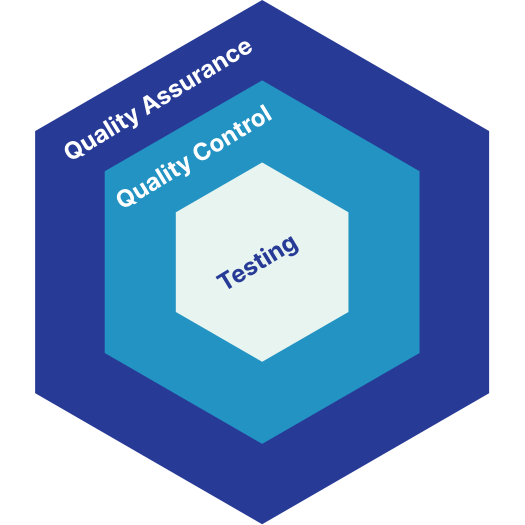
Tests on products are a component in Quality Control (QC), which forms a part of a complete Quality Assurance (QA) routine. It’s a critical step prior to deploying or releasing of a software application. It is, however, necessary to differentiate between QC and QA.

Quality Control focuses on ensuring the quality of a product by performing tests, finding flaws, and correcting them. QC also determines if the product meets the client’s requirements. Testing, bug fixing, optimization, and other aspects of Quality Control must be completed before the product or feature moves to the deployment stage of the development process.

QA Standards for Software Development

To make quality requirements more uniform, engineers have designed specific strict rules and practices to be applied in various industries. The International Standards Organization has a family of standards for quality management labeled ISO 9000. Within this family, the document ISO/IEC/IEEE 90003:2018 sets specific guidelines for implementing the standard ISO 9001 for a quality management system in the field of software engineering.

Most Common Techniques in QA

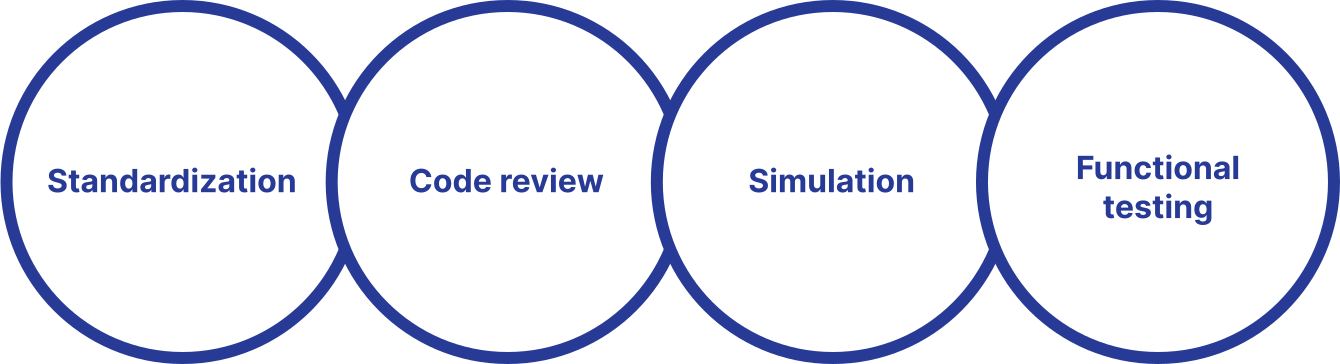
Quality Assurance specialists have several methods and established processes at their disposal. As an example, five of the most widely used techniques in the context of software development are briefly described below.

Most Common Techniques in QA

Quality assurance methods in software development

Standardization
Standardization

The method is employed to establish if the item, feature, or method meets the standard. In this case the relevant standard typically is ISO 9001.

Code review
Code review

This activity represents the “classic testing” aimed at finding bugs in the code and is most commonly associated with QA. This is one of the crucial steps to prevent flaws from becoming bigger problems at subsequent stages of the software development life cycle

Simulation
Simulation

This technique allows developers to observe how the simulated program would behave under normal working conditions. This is done when the software build is not ready physically, so a virtual model is created.

Functional testing
Functional testing

Specialists use this technique to see what the current build of the software can do in the context of its intended functions.

Stress testing
Stress testing

The name suggests that tests for stress are designed to determine how the program will handle circumstances that are beyond the normal operating parameters.

It should be noted that this list is merely illustrative and not exhaustive. Many other techniques can be used for QA purposes, including auditing, static testing, design analysis, etc.

PDCA Cycle in Software Development

One of the quality assurance methods in software development is the PDCA cycle. It is used as a repetitive process of making changes for the improvement and optimization of features and products. The cycle consists of four steps that are repeated until all flaws are corrected. The names of the steps make up the abbreviation “PDCA”:

Quality assurance process in software development

Plan

Plan

In this step, the specialists pinpoint the problem that must be corrected. If several problems are discovered, then priorities must be established. Each problem or flaw is considered an opportunity to make an improvement. Then specialists set the objectives and design the optimal course of action. They define the schedule with deadlines and assign executives to carry out every set task.

Do

The plan is set to action. The assigned specialists with the required skills perform every objective according to the plan. This process is monitored, and data is gathered to be analyzed later.

Do
Check

Check

In the next step, the steps taken during the next step are reviewed, and then conclusions about the outcomes are drawn. If the actions weren’t enough to improve the situation then, additional adjustments are made.


Act

The last step involves taking an action that is based upon the research that was conducted during the third step, and the information obtained during the three previous stages. If the issue is resolved then the actions used to solve it can be recorded to be a possible solution for future analysis. So, in the event that another similar issue occurs later on it will have an effective and precise method to resolve the issue. If the issue persists, the original plan and goals are revised according to the information gathered The cycle continues until the right solution is identified.


Act

In software development, the PDCA cycle not only leads to the improvement of the product but also enhances the existing methods of Quality Assurance and Control. The documentation of problems and processes helps in finding new solutions and preserving effective ways of finding and preventing flaws. It also helps in teaching specialists about newly invented tools and practices of QA.

Benefits of Quality Assurance in Software Development

Since QA is focused on improving the quality of a software product, it has an immense potential of providing various advantages both for product owners as well as for users. Let’s review the benefits that arise from better quality.

Higher efficiency
Higher efficiency

A top-quality software product runs much better than one with subpar quality. This means that the software performs its intended functions faster, which saves users’ time and improves productivity.

Better reliability

Better reliability

QA makes sure that the final software is a safe product and can withstand prolonged periods that are in continuous use, in addition to stress situations. In other words, a software product won't crash when subjected to extreme loads. This helps prevent the loss of data or any other negative effects.

Improved security
Improved security

Quality Assurance is essential for providing the best possible protection of confidential data, which is one of the main requirements across all industries. This is especially true for such areas as healthcare, retail, and other businesses that deal with personal information, payments, etc. For example, Quality Assurance is responsible for making a healthcare software application HIPAA-compliant. QA ensures that storages that contain sensitive data are protected from break-ins and the related infrastructure is secure against malicious attacks.

Enhanced functionality

As a result of QA processes, the final software product should have all the intended functions as set in the specifications. Quality Assurance oversees the proper implementation of the functions and the correct integration of the software into its working environment, infrastructure, networks, etc.

Less maintenance
Easier maintenance

QA makes sure that the software product can be easily maintained and adjusted according to changed conditions, if necessary. Even when a client requires a limited set of software features, Quality Assurance specialists should enable the possibility of adding more features in the future. According to QA practices, a software product must be allowed to evolve and improve.

To Conclude

If you want to ensure the flawless quality of your product, Contact us SyanSoft has team of experts to provide you with a wide range of QA and testing services. Our Quality Assurance engineers will oversee the whole software development life cycle and perform comprehensive testing and optimization. They will make sure that your product is built according to your requirements and in  line with quality standards.