 Skip to content
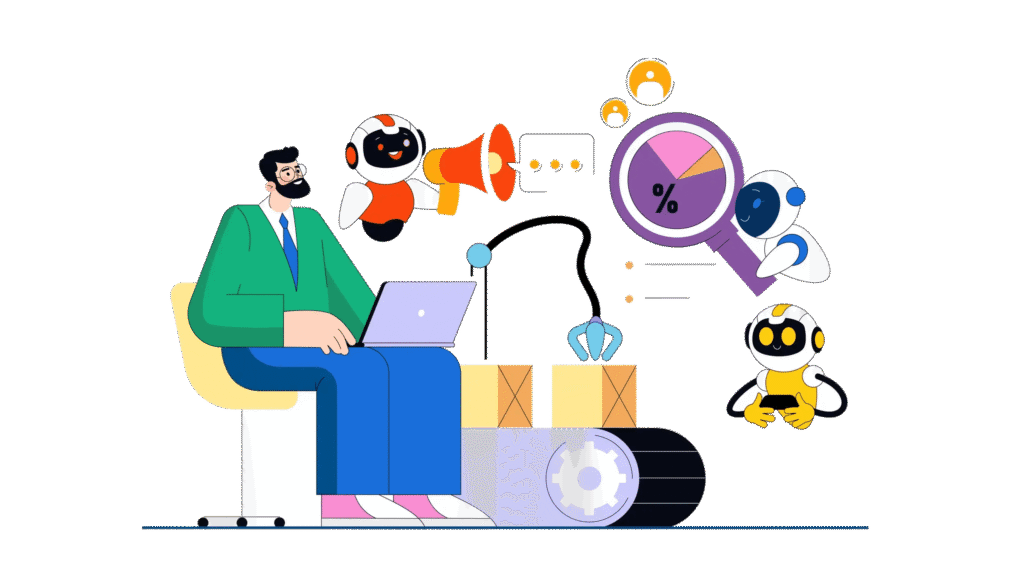
Lead generation is changing rapidly. In 2026, businesses are moving beyond traditional marketing automation toward AI-powered marketing systems that can understand customer intent, predict behavior, personalize experiences, and automate decisions in real time.
For companies looking to generate better-quality leads, AI marketing is no longer simply an emerging technology. It is becoming an important part of modern digital marketing strategies. From AI-powered search and predictive analytics to intelligent chatbots and automated lead nurturing, businesses can now connect with potential customers at the right moment with more relevant messaging.
What Is AI Marketing in 2026?
AI marketing in 2026 refers to using artificial intelligence, machine learning, generative AI, predictive analytics, and intelligent automation to improve marketing activities and customer acquisition.
Instead of relying entirely on predefined rules, AI-powered systems can analyze large volumes of customer and marketing data, identify patterns, understand intent, and recommend the next best action.
For example, an AI marketing platform can help a business:
- Identify high-intent prospects
- Personalize website and campaign experiences
- Predict which leads are most likely to convert
- Automate follow-up communication
- Generate and optimize marketing content
- Analyze campaign performance
- Improve customer journeys across multiple channels
The result is a more responsive and data-driven approach to lead generation.
How Intelligent Automation Is Changing Lead Generation
1. AI Is Improving Lead Qualification
AI helps businesses identify high-quality prospects by analyzing website behavior, content engagement, search intent, previous interactions, and campaign responses. AI-powered lead scoring allows sales teams to prioritize prospects based on their likelihood to convert.
2. Predictive Analytics Helps Identify Buying Intent
Predictive AI can analyze historical and real-time data to recognize patterns linked to purchasing decisions. Repeated service-page visits, pricing interactions, resource downloads, or chatbot conversations can signal strong buying intent, allowing marketers to take action earlier.
3. Personalization Happens at Scale
AI enables businesses to deliver personalized content, recommendations, offers, and messages based on customer interests, behavior, industry, and buying stage. This creates more relevant customer experiences while reducing unnecessary communication.
4. AI Chatbots Are Becoming Lead-Generation Assistants
Modern AI chatbots can answer questions, collect information, qualify prospects, recommend services, and transfer promising leads to sales teams instantly.
5. AI Search Is Changing How Customers Discover Businesses
Businesses must optimize content for traditional search, AEO, and GEO by creating clear answers, structured content, FAQs, trustworthy information, and strong topical authority.
AI Marketing and the Future of the Customer Journey
The future of lead generation is not about replacing marketers or sales professionals with AI. It is about creating an intelligent collaboration between people, data, and automation.
A modern AI-driven customer journey may look like this:
Search → AI Recommendation → Website Visit → Personalized Experience → AI Qualification → Automated Nurturing → Sales Conversation → Conversion
Each stage can use customer signals to determine what should happen next.
This creates a more connected marketing funnel where automation supports prospects throughout their buying journey.
Why Businesses Should Invest in AI Marketing
Businesses adopting intelligent marketing systems can potentially benefit from:
- Faster lead qualification
- More personalized customer experiences
- Reduced manual marketing tasks
- Better utilization of marketing data
- More efficient lead nurturing
- Improved alignment between marketing and sales
- More scalable customer acquisition
However, successful AI marketing requires more than implementing an AI tool. Businesses need reliable data, clear objectives, strong content, appropriate automation workflows, privacy considerations, and measurable KPIs.

How SyanSoft Technologies Can Help
SyanSoft Technologies helps businesses explore AI-driven solutions that support smarter digital transformation and business growth.
From AI integration and intelligent automation to AI-powered business solutions, organizations can build systems designed around their specific operational and marketing requirements.
The goal is simple: use AI strategically to improve efficiency, customer engagement, decision-making, and business outcomes.
Conclusion
AI marketing in 2026 is transforming lead generation from a campaign-based process into an intelligent, continuous customer journey.
Businesses can use AI to understand intent, identify promising prospects, personalize experiences, automate engagement, and make faster marketing decisions.
The organizations that benefit most will not simply adopt AI because it is trending. They will connect AI with clear business objectives, quality data, strong content, and customer-focused strategies.
For businesses ready to build a smarter and more scalable approach to lead generation, SyanSoft Technologies can help turn AI opportunities into practical business solutions.